






Mobi 4.4: Connect, Automate, and Unlock Your API’s Full Potential
Released on July 2nd, 2026, version 4.4 continues our commitment to full operationalization of semantic artifacts, powering dynamic knowledge graph solutions, and solving your critical data harmonization needs. This minor release makes a major leap forward in system integration capabilities, introduces a powerful new event-driven automation framework, dramatically improves the REST API experience for developers and AI tooling, and delivers precision control over how your data is represented as RDF. Check out the details below!
Webhooks: Event-Driven Integration for the Real World
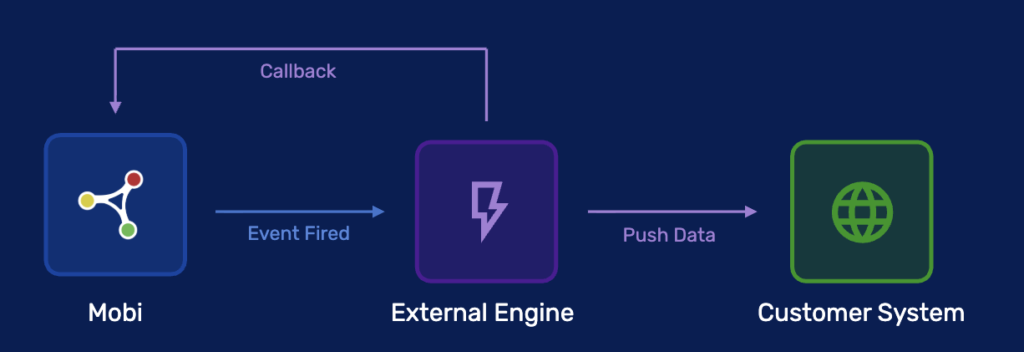
Modern semantic data management doesn’t happen in isolation — your ontologies, mappings, and datasets need to be connected to the broader ecosystem of pipelines, ETL tools, and downstream systems that your organization depends on. Mobi 4.4 introduces a brand-new Webhooks framework that enables exactly that. You can now create Webhook Records directly from the Mobi Catalog and configure them to fire outbound HTTP requests in response to events happening inside the platform. When a commit is made, a tag is added, or other catalog-level activity occurs, Mobi can automatically notify external systems — no custom scripting or polling required.
Event-based filtering ensures that webhooks only fire for the specific platform events you care about, keeping your external systems from being flooded with noise. Each webhook can be configured with a target URL, HTTP method, event filter, optional secret token, and custom request headers, with configurations validated automatically to ensure integrity before execution.
The framework is built with reliability and observability in mind. Each webhook execution is tracked as a provenance activity, giving you a full audit trail of when a webhook fired, what payload was sent, which connection attempts were made, and whether each attempt succeeded. A full REST API for listing, retrieving, updating, and managing Webhook Records rounds out the feature, and we’re excited to continue building on this foundation in future versions.
REST API and Swagger Docs: Built for the Age of AI Integration
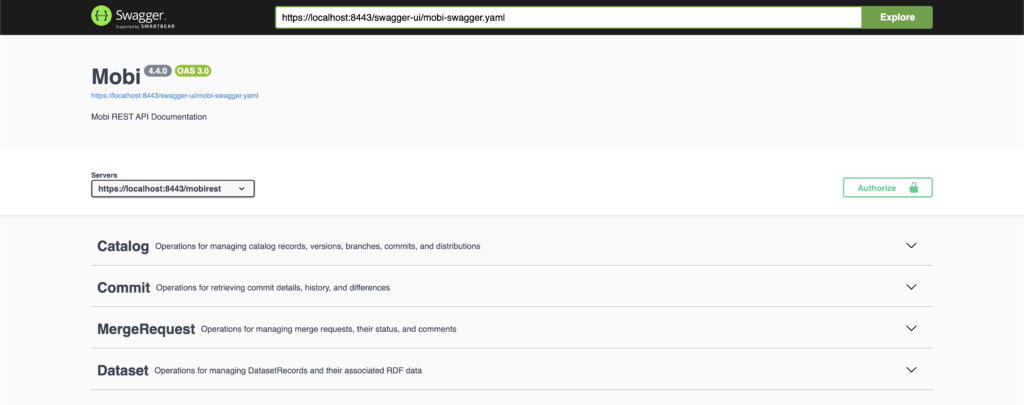
One of the most significant investments in Mobi 4.4 is a thorough overhaul of the REST API and its Swagger (OpenAPI) documentation — driven by a clear strategic goal: making Mobi’s API a first-class integration target for AI tooling, including Model Context Protocol (MCP) integrations. MCP is the emerging standard for connecting AI agents and large language models to external tools and data sources, and for Mobi to serve reliably in those workflows, the API needs to be precisely described, consistently structured, and machine-parseable.
To that end, every REST endpoint in the platform has been reviewed and brought to a consistent standard, with accurate operation summaries, structured error response bodies, and strongly-typed schema definitions that make the API contract trustworthy and suitable for automated client generation. The Swagger UI is now also accessible with a single click from the in-app Help menu, making it easier than ever for developers and integrators to explore and test the API against their own live installation.
Alongside these documentation improvements, several REST endpoints received functional upgrades as well — including support for the standard SPARQL JSON MIME type, richer repository endpoint responses, and a performance fix for the Datasets page load time. Check out the release notes for the full list of API changes.
Customizable IRI Templates in the Mapping Tool
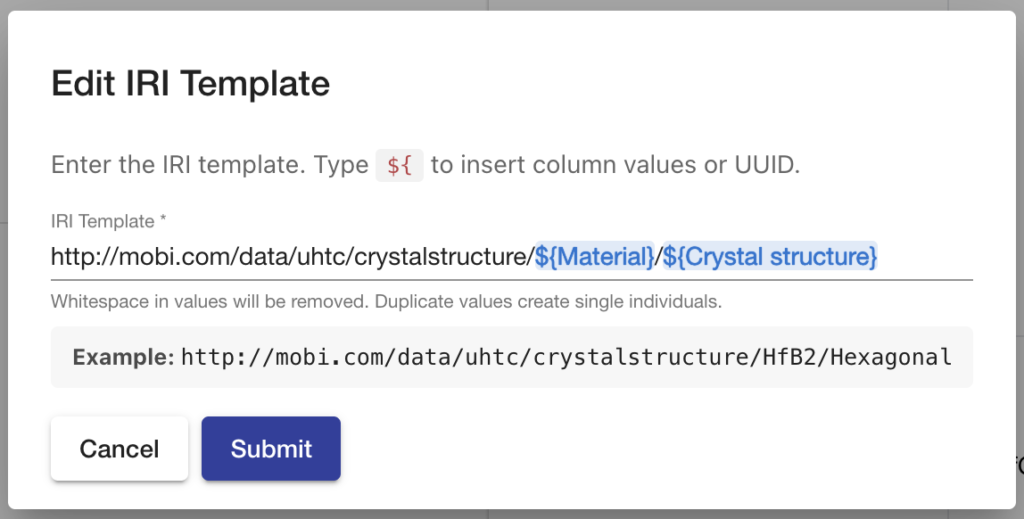
The Mapping Tool is at the heart of Mobi’s data harmonization capabilities, and Mobi 4.4 brings a long-requested enhancement to how IRIs are generated for mapped instances: fully customizable IRI templates. Previously, you could specify a prefix and a dynamically populated local name for a Class Mapping, but incorporating multiple data values or even setting a static IRI — for example, generating https://example.org/scheme/ABC/concept/12345 where ABC comes from one column in your file and 12345 comes from another column — required workarounds. Now you can define an IRI template with one or more ${} replacement patterns that are filled in at conversion time using values directly from your delimited source data.
The experience for building these templates is designed for ease of use. As you type ${ in the template field, a dropdown of column headers from your data file appears so you can insert replacements by name. An example generated IRI is displayed in real time using values from the first row of your data, and the field validates that the result will be a well-formed IRI before you ever run a conversion.
The Mapping Tool also now applies a standardized set of industry-standard namespace prefixes to all exported RDF content, producing cleaner and more readable serialized output that integrates naturally with downstream semantic tooling. Together, these enhancements give data modelers and knowledge graph prototypers significantly more control over the shape and quality of the RDF they produce — with no extra code required.
Ready to Get Started?
Contact us today to learn more about Mobi 4.4 and how it can transform your approach to semantic data management.
Capabilities
Open Business Solution Platform
Tap the full potential of your enterprise data to deliver fresh insights.
Collaborative Data Modeling
Bring your team or community together to create, share, and evolve data models in a modern, web-based, collaborative environment.

Automated Data Enhancement
Mobi makes it easy to integrate data into your models. The included mapping tool aligns your data to generate interoperable data without writing a single line of code.

Intuitive Data Exploration
Bundled tools make it easy to search and explore your enterprise data without the hassle of writing queries or analyzing models. Oh, and the query tools are there too.

Modular & Extensible
Pluggable backend storage solutions, open REST and Java APIs, and a plugin framework make it easy to build solutions that extend and customize the Mobi Platform to solve your business problems.